Some of the best food in Siargao isn’t on any restaurant or resort menu.
After one and a half years living in Northern Siargao, I discovered that the island’s real delicacies—sea urchin and danggit kilaw, backyard-cooked lechon, buwa(coconut nut)—happen in homes, not restaurants. These Siargao food delicacies exist outside tourist guides, shared between locals who understand that food is how communities function.
This isn’t about hunting down the best restaurant in Siargao or chasing the dishes that make for the best Instagram posts. It’s about what happens when you stop being a tourist and start living within your community. It looks like your neighbor showing up at dawn with freshly caught seafood, birthday parties that somehow feed dozens, and meals so good they cost nothing because sharing is simply how things work.
These seven experiences represent authentic Siargao foods and delicacies—not what’s served to tourists, but what locals actually eat. From famous delicacies in Siargao like sea urchin kilaw to things you’ve never heard of like buwa, this is food culture that only reveals itself when you live here long enough to become part of it.
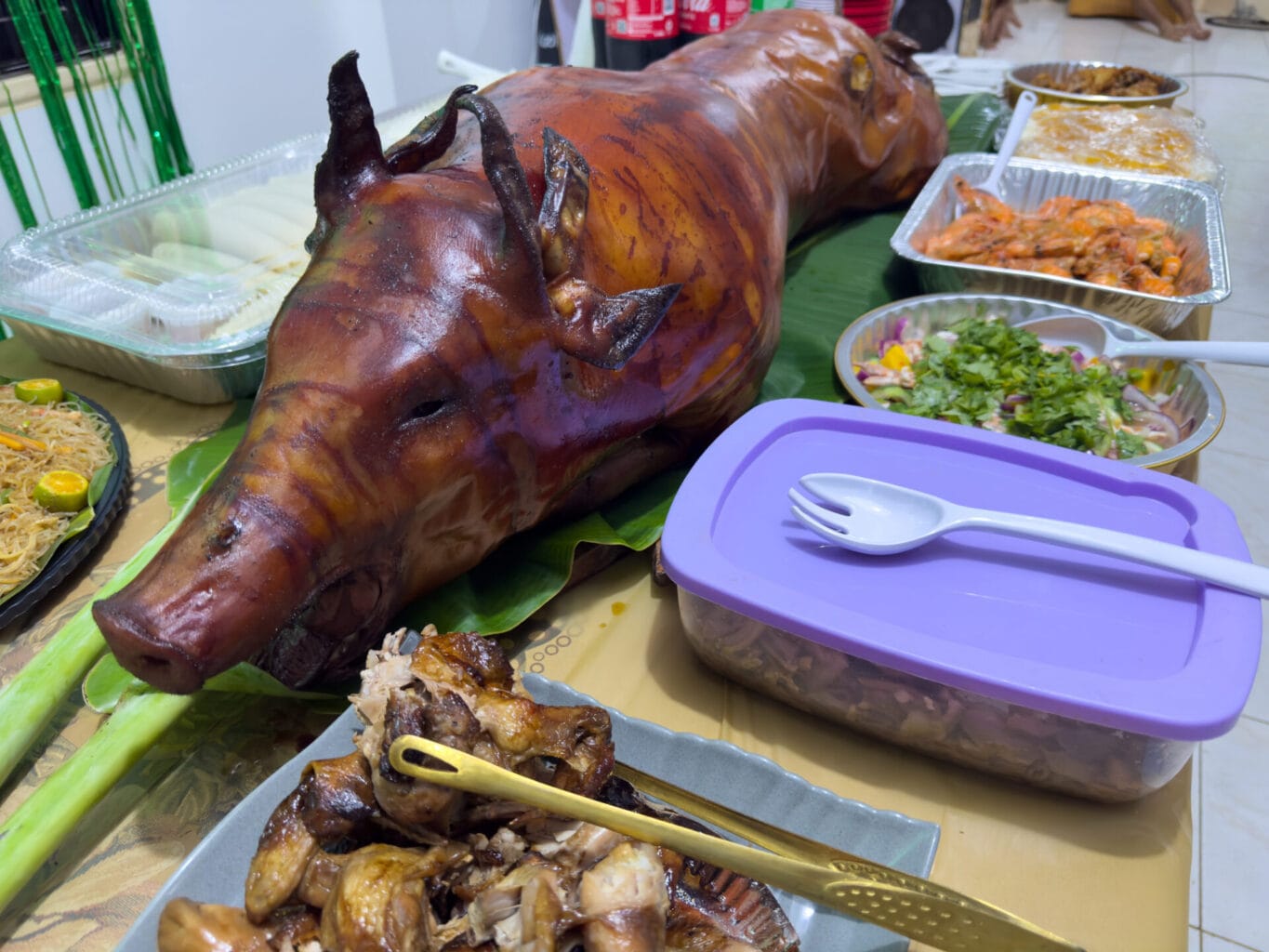
My Birthday Lechon, Raised and Cooked in Barangay Garcia
The pig knew.
That’s the part they don’t tell you about lechon, one of the most famous delicacies in Siargao and throughout the Philippines. Not in the glossy food magazines with their photos of crackling mahogany skin, not in the breathless Instagram posts hashtagging #LechonGoals. The pig squeals the entire time, a sound that follows you home and sits with you while you’re trying to sleep that night. It’s aware of what’s coming, and if you’re going to participate in this—really participate, not just show up at the end with a plate of rice and a Red Horse beer—you have to sit with that discomfort.
It was my birthday. I’d been living in Barangay Garcia in Northern Siargao for over a year, long enough that I wasn’t a tourist anymore but not quite local either. Somewhere in that liminal space where the school principal knows your name and will sell you a pig from her pen, where your local friend Cesar becomes your guide into the process you’ve only witnessed superficially before.
I’d eaten pork lechon before. On my very first trip to the Philippines when I met Love, we had ordered one for her father’s birthday from a lechonaria in Surigao. I watched from a comfortable distance then, the kind of distance that lets you enjoy the spectacle without confronting the mechanics. This time would be different. This wouldn’t be restaurant food in Siargao. This would be the real thing, cooked the way it’s been cooked for generations.
The Process Begins
Cesar’s brother-in-law is a lechonero, just like his father was, and his grandfather before that. This is generational knowledge, the kind that doesn’t get written down in cookbooks or taught in culinary schools. You learn it by doing, by spending countless hours over charcoal fires, by understanding the exact moment when the juices need draining and when the skin needs one more pass of heat.
We hired him to guide us through the process. From slaughter to seasoning to fire-building to the final cook, but the size of the pig we ordered demands more hands than one person should provide. So Cesar and I became his crew for the day, which felt right. You pay for expertise, but you also show up. You participate.
The slaughter happened at the lechonero’s backyard. I won’t romanticize this part. As a city dweller, as someone who grew up buying meat in plastic-wrapped packages from refrigerated cases, I was shellshocked. The squealing doesn’t stop. It echoes off the walls and the trees and settles somewhere in your chest. But I stayed. I watched. Because if I was going to eat this animal, if I was going to celebrate my birthday with its flesh as the centerpiece of a feast, the least I could do was bear witness.
The locals walking by didn’t share my crisis of conscience. They smiled. Some called out. Even with my limited Visaya, I could hear the word “lechon” and see the recognition light up their faces. Lechon means celebration. It means abundance. It means someone is doing well enough to afford this kind of extravagance, and they’re generous enough to share it.
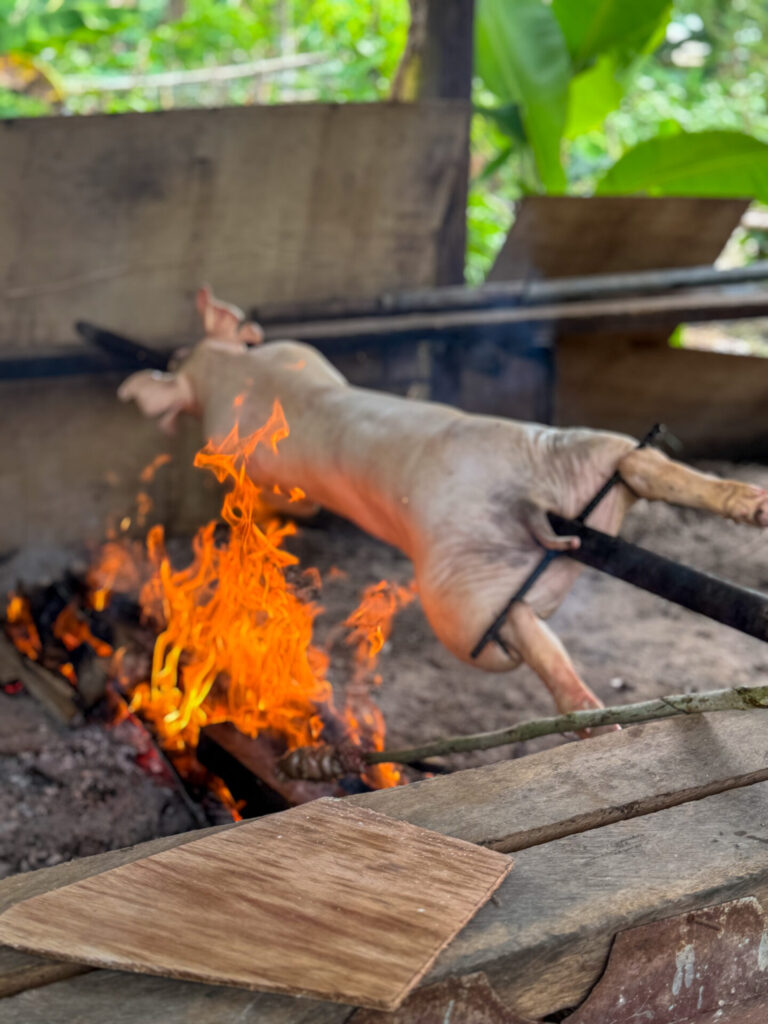
Four Hours Over Fire
Four hours over charcoal fire. That’s what it takes.
The lechonero built the charcoal bed at his house with his own firewood, arranged the coals with the precision of someone who’s done this hundreds of times. We were about a mile inland from the water, in the heart of the barangay where chickens scratched in yards and neighbors could smell what we were cooking from several houses away.
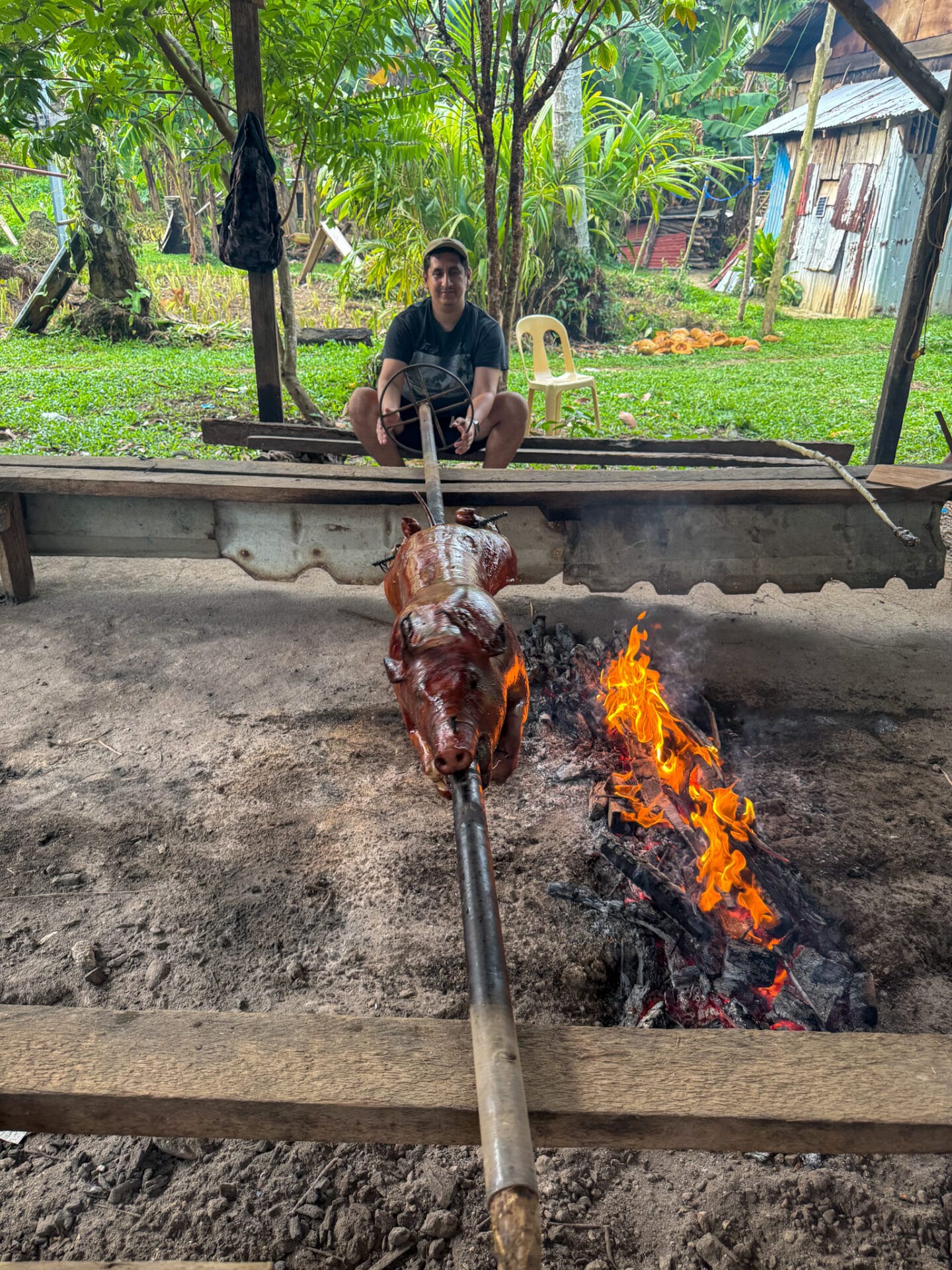
Cesar and I took turns with the lechonero on the rotation. This wasn’t Cesar’s first time spinning a lechon; his hands moved with practiced confidence, understanding the rhythm without needing instruction. Not too fast, not too slow. Constant attention but not constant motion. My hands got dirty with charcoal dust, smoke curling around us, sweat rolling down our backs in the afternoon heat.
This is when the education happened. Not in dramatic pronouncements or formal instruction, but in the casual cadence of men working together. The lechonero periodically drained the excess liquid from the cavity, letting it hiss and spit into the fire below. “Too much salt inside,” he explained through Cesar’s translation, gesturing to the steady stream. Generations of knowledge compressed into a single gesture, understanding that you can’t just season and hope for the best. The fire becomes part of the process, drawing out excess, concentrating flavor, creating balance.
The Conversations Between Rotations
Cesar pointed out the purple chilis growing in the neighbor’s yard, some of them still ripening on the tree. Small, fierce little things that pack some heat. We talked about fishing, about who caught what and where. The kind of easy conversation that happens when hands are busy and time moves slowly. Local dogs circled at a respectful distance, noses working overtime, licking their chops in anticipation of scraps they knew would eventually come.
Somewhere in the third hour, the lechonero pulled out a bottle of Coke. Not to drink, but to paint. He brushed it over the skin in the final stages, the sugar and caramel color creating that deep mahogany sheen that makes lechon lechon. A trick born from practice, from understanding how fire and sugar and rendered fat create something greater than the sum of their parts.
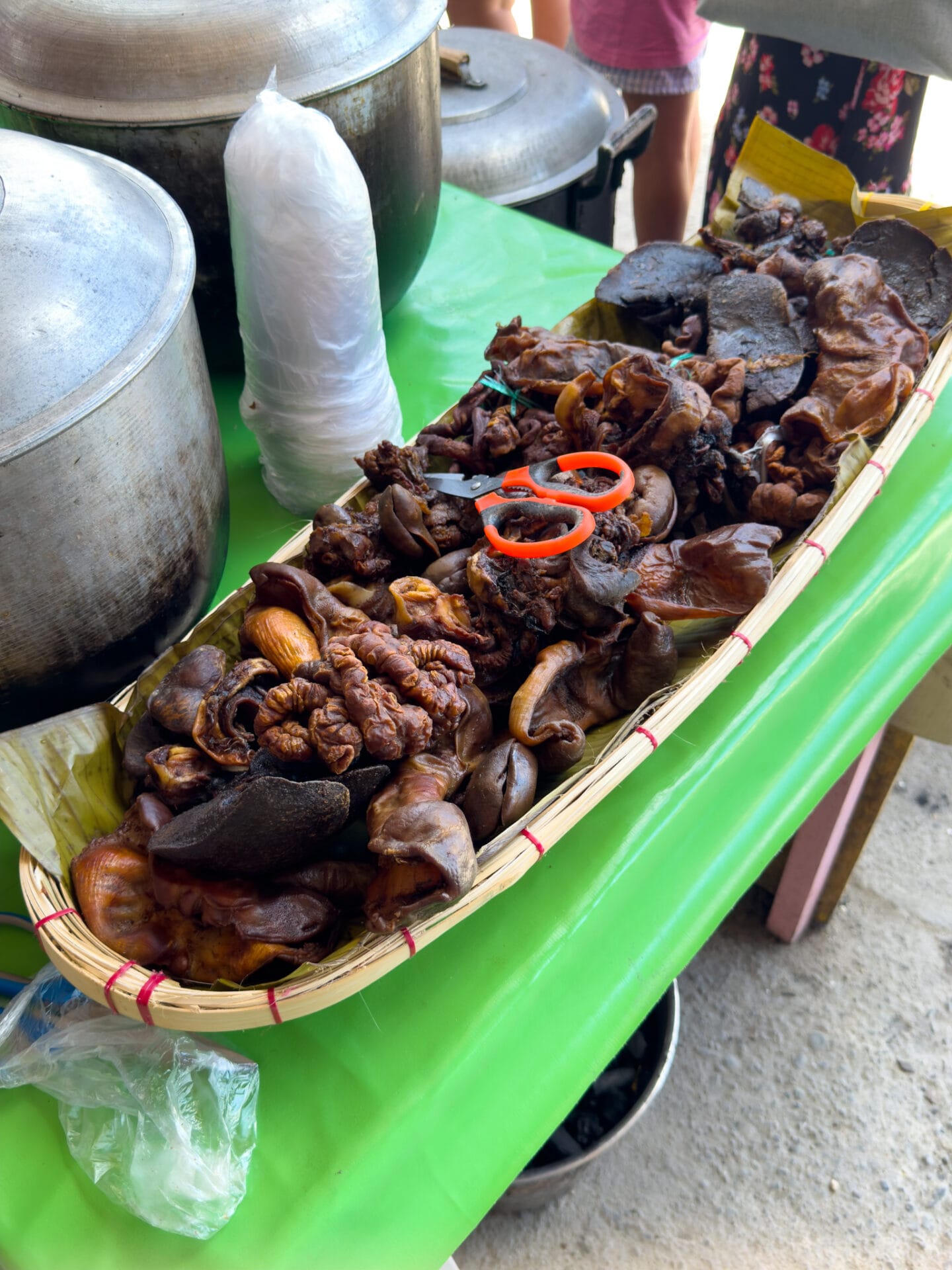
The Cook’s Reward
While the lechon spun and crisped, the lechonero prepared what might be called the cook’s tax—the organs. Liver, kidneys, the inner bits that don’t make it into polite food photography but have sustained working people for as long as animals have been slaughtered.
He cooked them separately, char-grilled over the same fire, then sliced them into bite-sized pieces. The dipping sauce was simple: soy sauce, coconut vinegar, and some local siling labuyo chilis from his yard. He offered them around.
I’m not an organ guy. Never have been. There’s a irony taste, a psychological hurdle I’ve never quite cleared even after years of trying to appreciate offal the way chefs insist you should. But here, in this context, with these men who’d spent hours working this fire with me, refusal felt wrong.
So I tried them. And somehow, maybe it was the smoke, maybe it was the bright acid cut of the vinegar against the richness; I found myself going back for more. Snacking on kidneys and liver like they were bar nuts, the chilis providing little detonations of heat that kept things interesting.
This is the kind of Siargao food experience you won’t find when you google “best restaurant in Siargao” or served at the trendy resorts in General Luna. This is what happens when you’re invited into someone’s backyard, when you participate rather than just consume.
Setting the Table
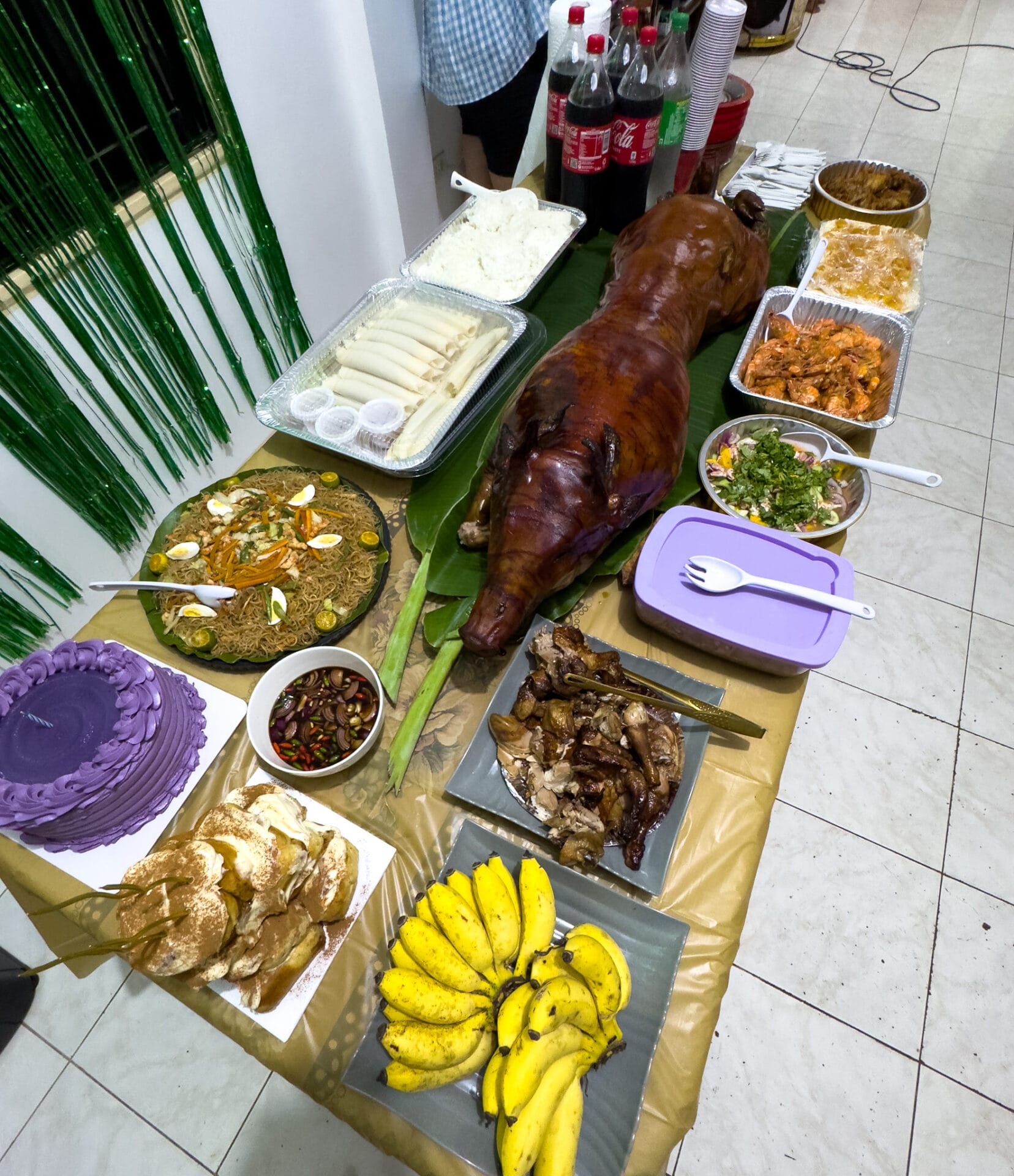
When the lechon was finally done, skin crackling and bronze, fat rendered into submission, the whole animal transformed into something that smelled like every celebration you’ve ever wanted to attend—we carried it home. Carefully. Reverently. The kind of precious cargo that makes you walk slower and more deliberately than usual.
We laid it on banana leaves in the center of our dinner table, and suddenly our modest home in Barangay Garcia looked like the setting for something important. Which, I suppose, it was.
Here’s the thing about lechon: you don’t just serve lechon. That would be like throwing a party and only offering one conversation topic. The whole point is abundance, is variety, is the sprawling generosity of a table that can’t quite contain everything that’s been prepared.
Love had gone into town and returned with ube cake, cinnamon rolls, fresh lumpia, and mango float—that gloriously simple Filipino dessert of graham crackers, cream, and mangoes that tastes like childhood and summer compressed into layers. We’d also picked up lechon manok, pancit, and buttered shrimp, because apparently one roasted animal wasn’t enough.
I’d prepared my own contribution: an adapted version of the shrimp ceviche with mango that I’d been craving since leaving the West Coast. All local ingredients, but prepared the way I knew, the way that reminded me of home. I’d even managed to find some bags of tortilla chips.
Love rented a videoke machine from Ate Vickie, because Filipino birthdays necessitate videoke the way American birthdays necessitate cake. There are rules to these things, unwritten but absolute.
We laid out bottles of Fundador rum and Coke. Guests brought local bananas. Everything was ready. We’d planned for maybe fifteen, twenty people. Close friends, neighbors we’d gotten to know over the past year.
We had no idea.
When Everyone Shows Up
Thirty to forty people showed up, maybe more. At a certain point you stop counting and just start making sure there’s enough food.
Some were invited. Others were friends of friends. Neighbors who’d smelled the lechon from three houses away figured, correctly, that they’d be welcome. And then there were the random local kids—Love pointed this out to me with barely concealed amusement—children we’d never seen before in our lives. They just appeared. Drawn by the gravitational pull of the crispy-skinned lechon and the general understanding that when someone in the barangay is celebrating, the celebration belongs to everyone.
This is what I’d failed to understand about lechon, about Filipino celebrations in general. They’re not private affairs. You don’t send invitations with RSVPs and plan portions accordingly. You get more than you think you’ll need, and then you trust that it’ll work out, that the mathematics of generosity operate on different principles than scarcity economics would suggest.
The Mathematics of Generosity
The lechon disappeared in a way that felt almost biblical. Hands reaching, plates filling, everyone taking what they needed but not more than that, the whole thing somehow feeding forty people when it should have reasonably fed twenty. We’d gone with a mid-sized pig (15,000 pesos total, roughly $270 USD)and watching it get demolished in real-time, I understood why the lechonero’s father had taught him this trade, and why he’d taught his son.
The videoke machine worked overtime. Fundador flowed. My shrimp ceviche, my little attempt to bring something of myself to the table, got eaten, though I noticed with some amusement that most people were scooping it onto rice instead of using the tortilla chips. Cultural adaptation works both ways.
By the end of the night, we had leftovers. Mountains of them, despite the crowd. I packed up everything we couldn’t possibly store in the refridge and distributed it to our friends and neighbors as they went home. More generosity mathematics—the food had done its job, brought people together, created something communal. Keeping it all for ourselves would have missed the point entirely.
Sea Urchin and Danggit Kilaw
The thing about drinking Fundador with Cesar is that he doesn’t get hangovers. Or if he does, he handles them the way locals have handled them for generations: by waking up at dawn and going to work anyway.
I, on the other hand, was still processing the previous night when he showed up at our place around 7 AM, casual as ever, mentioning something about going fishing and bringing back seafood. I nodded. Said “okay, sounds good” in that half-conscious way you agree to things when you’re still mostly asleep. Then I went back to bed, assuming this was the kind of plan that sounds good in theory but rarely materializes in practice.
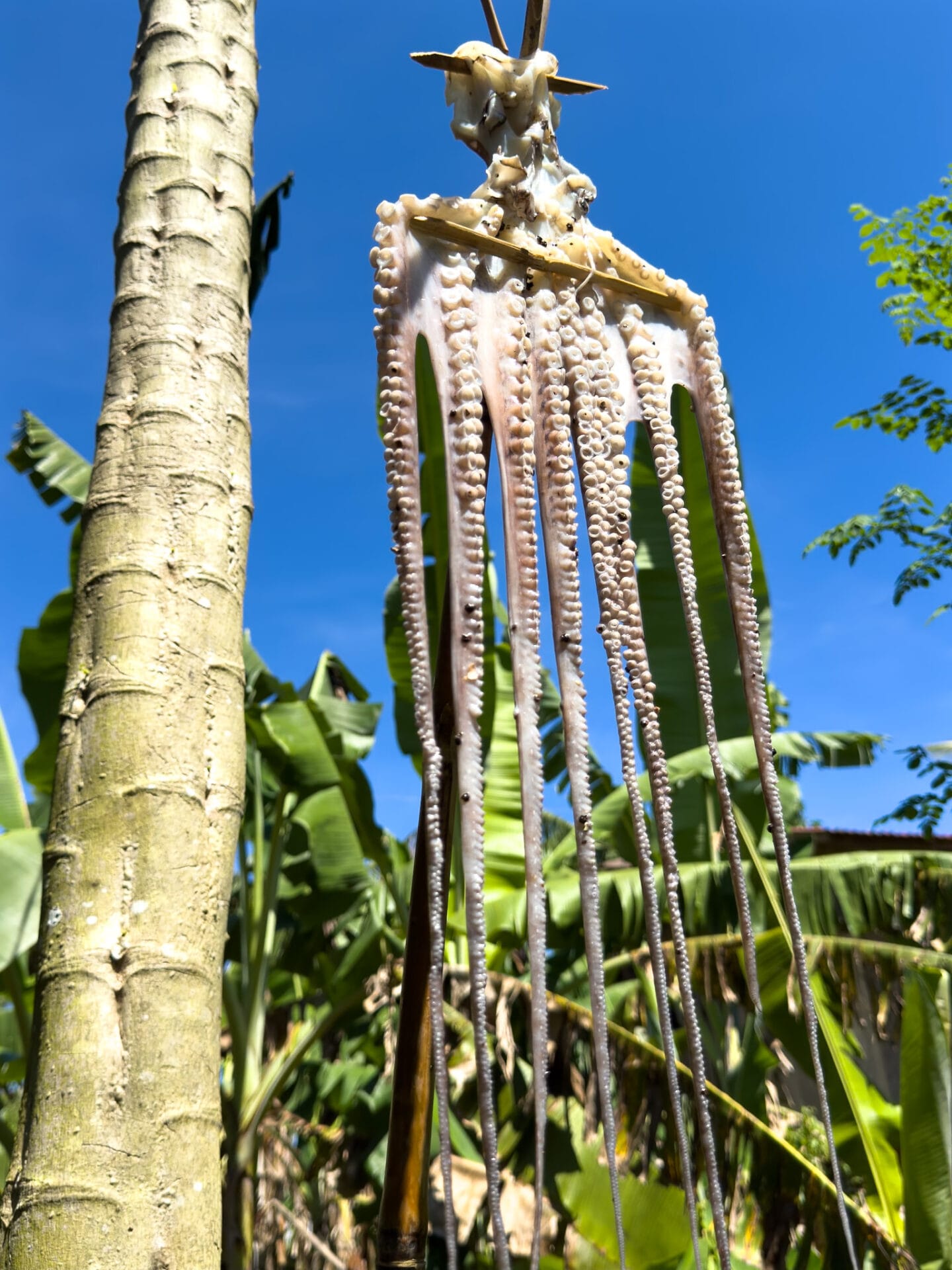
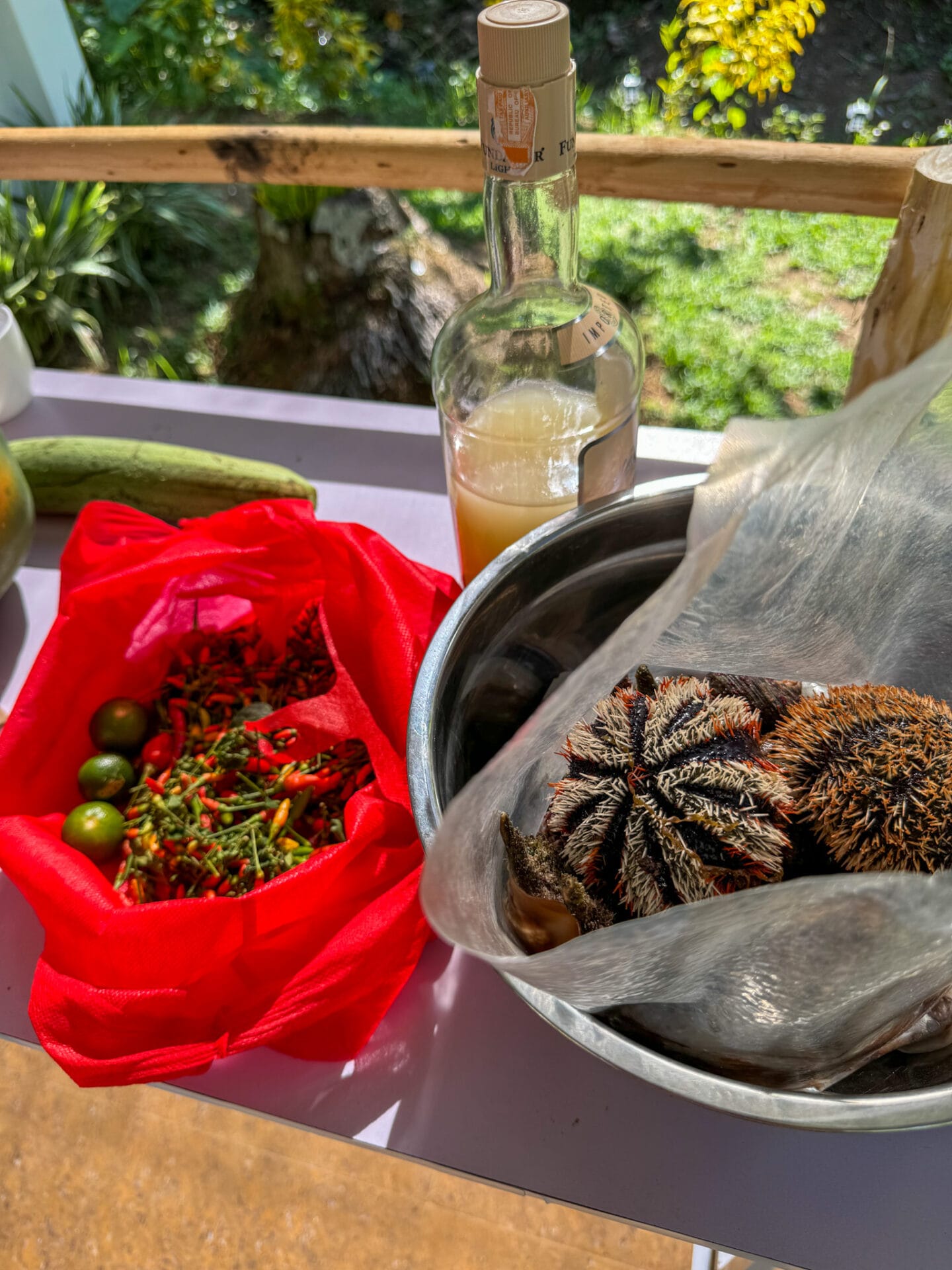
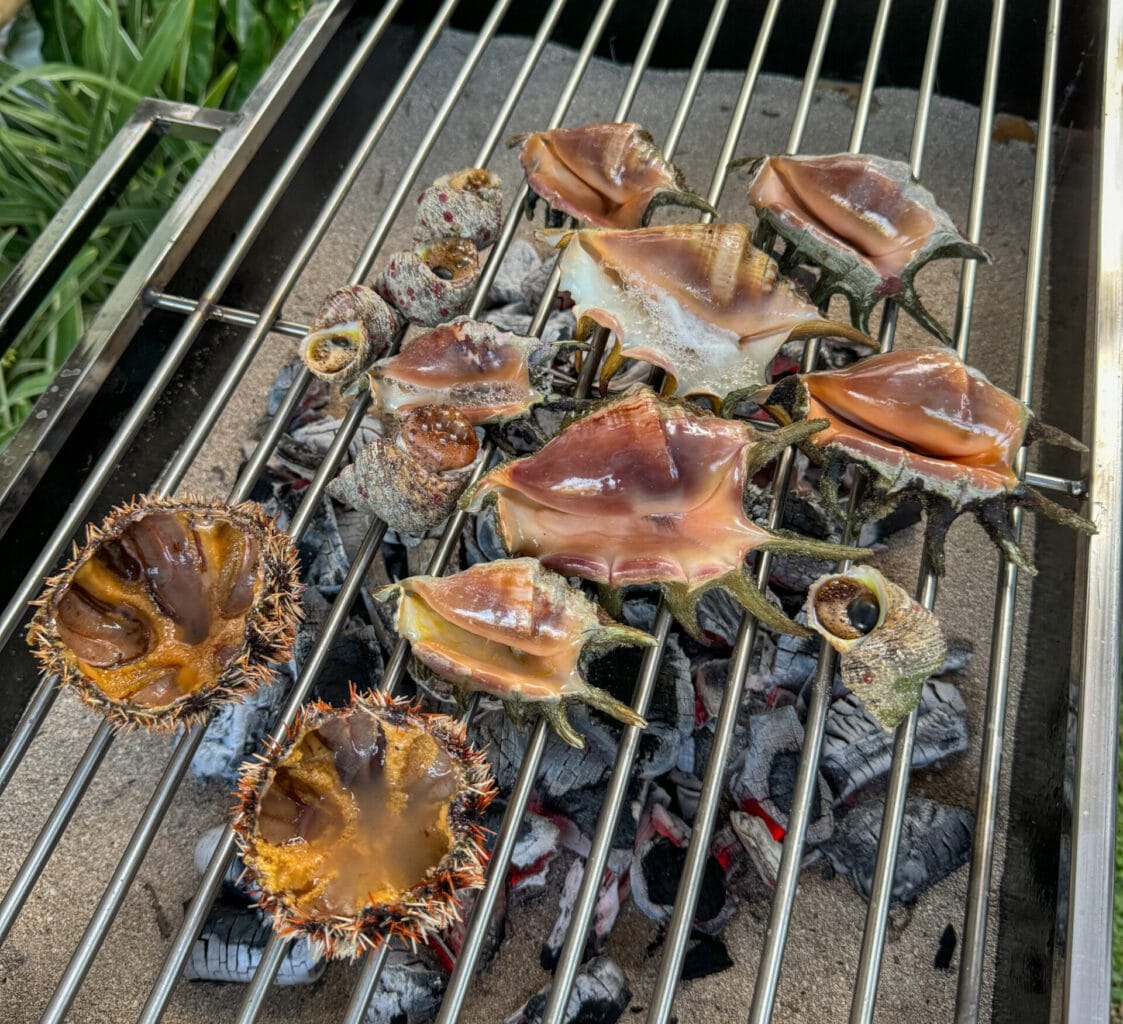
Two hours later, Cesar was back at our door. With octopus. Sea urchin. Conch. Fresh danggit. All of it pulled from the water that morning like it was nothing, like the ocean was his personal pantry and he’d just swung by to pick up a few things.
This was November in Siargao, when the seas were giving up their abundance and locals knew exactly where to look and when. He’d brought enough that some would need preserving. One of the octopuses was already destined to be hung with a bamboo pole and sun-dried, the traditional way of dealing with seasonal excess, turning it into pulutan for future drinking sessions.
But first, he wanted to show me something I’d never tried. This is the kind of best seafood in Siargao that doesn’t come from restaurants, it comes from knowing someone who fishes, someone who’ll show up at your door with the ocean’s harvest still dripping saltwater.
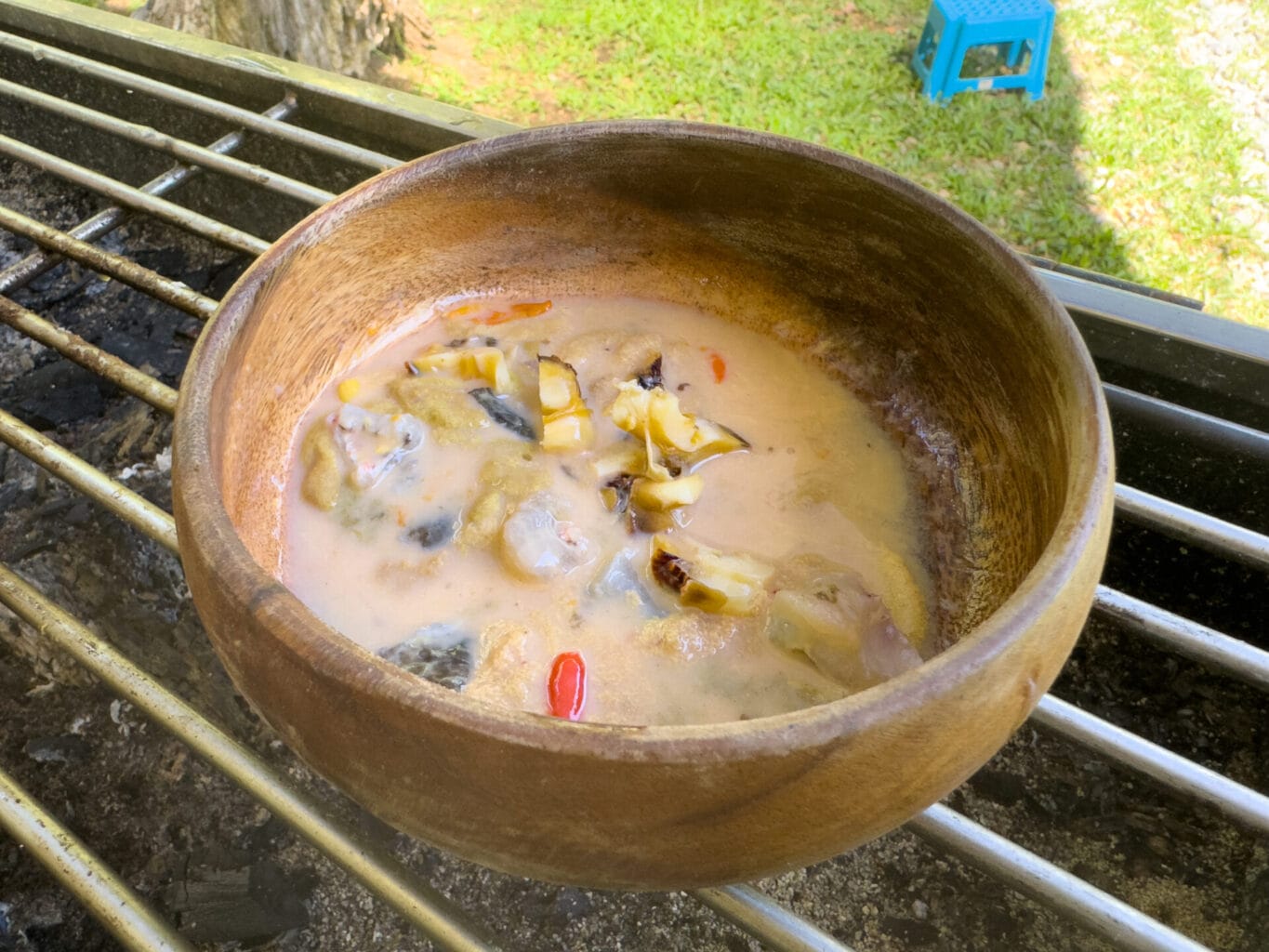
Eating Sea Urchin
Cesar set up in our front yard near the BBQ grill, the morning sun already starting to assert itself. He asked me to grab our coconut vinegar, some fresh chilis, a knife, and a cutting board. The kind of minimal equipment list that signals either disaster or brilliance, depending on who’s doing the cooking.
This time, it was the latter.
He picked up one of the sea urchins and cracked it open with the practiced efficiency of someone who’s done this a hundred times. Inside, nestled against the shell like liquid gold, was the uni. The roe. It looked like a couple spoonfuls of mustard, creamy and orange and impossibly fresh.
He scooped it out into a bowl. Then another urchin. Then another. Three or four give or take, each one yielding its treasure without ceremony. He poured in our spiced vinegar, local labuyo chilis already infused into the coconut vinegar, giving it heat and complexity. Then he took the fresh danggit, the rabbitfish he’d caught that morning, and diced it up raw. Added it to the bowl with the uni, vinegar, and fresh chilis.
That was it. No elaborate technique. No lengthy preparation. Just four elements (sweet sea urchin roe, raw diced rabbitfish, chili-spiked vinegar, and some more chilis) combined in a bowl in our front yard while chickens scratched around nearby and the hangover I’d been nursing suddenly felt less important.
“Kilaw,” Cesar said, pushing the bowl toward me.
This was probably the most simple kilaw I’d ever encountered. And one of the best.
Trying Sawa, or Reticulated Python
Some food experiences you seek out. You read about them, plan for them, travel to the right restaurant at the right time of year to taste the thing you’ve been dreaming about.
Other food experiences just show up at your door in a plastic container, delivered by your local friend with a smile that suggests he knows exactly how wild this is about to get.
Cesar appeared one afternoon with a clear rectangular container, the kind you’d use for leftovers or meal prep. Inside were chunks of meat, uniform pieces in a dry preparation, dark with spices, whole black peppercorns visible throughout. It looked, at first glance, like adobo. Which it was. Technically.
“Try it,” Cesar said, still smiling. “It’s cooked adobo style.”
Then, almost as an afterthought: “It’s python.”
Not just any python. Sawa. Reticulated python. The massive, non-venomous constrictors that can grow to over twenty feet, that have been known to kill and swallow adult humans whole in Indonesia, that live in the jungles of Siargao and occasionally wander into human territory looking for easier prey than wild pigs.
This particular python had made the fatal mistake of hunting chickens in a barangay near Garcia, closer to the jungle, further from the shore. Got caught in someone’s chicken coop. And because nothing goes to waste when you live in a place where food security is never guaranteed, the snake became sustenance instead of just a carcass to discard.
What Sawa Tastes Like
I didn’t hesitate. Not because I’m particularly brave or adventurous, but because the opportunity was too strange, too specific to pass up. When does a foreigner in the Philippines get offered python that was caught that week hunting chickens in a neighbor’s coop? When does that chance come around again?
Cesar didn’t stick around for my reaction. He handed me the container with that amused smile, said “try it, it’s cooked adobo style, it’s python,” and then sped off on his motorbike before I could ask any follow-up questions.
Love, standing nearby, gave me a look that clearly communicated her position: absolutely not. Hard no. It wasn’t about the taste, she’d acknowledge later that it tastes like chicken, which is what everyone says about snake and in this case happens to be true. It was the texture of the meat and the bones. Those thin, numerous, protruding bones that gave structure to each chunk of meat, visible reminders that you were eating something with a very different skeletal system than the animals we’re used to consuming.
I ate it straight from the container. No rice, no ceremony. Just standing there in our house, picking up chunks of dry adobo python with my fingers, Love refusing to participate, Cesar already gone down the road on his motorbike probably laughing to himself.
Python Adobo
The adobo preparation made sense once you started chewing. Python is muscular in a way that chicken isn’t; all that constricting power translated into tough, dense meat that needs breaking down. The vinegar and long cooking time of adobo does exactly that, tenderizes what would otherwise be nearly inedible. This version was heavy on the chilis, aggressive with heat, the whole black peppercorns providing occasional bursts of sharp spice. Tangy, very spicy, and unmistakably gamey.
The texture was somewhere between chicken and something wilder. Slightly tough despite the adobo treatment, with a chewiness that reminded you this animal had spent its life moving through jungle underbrush and squeezing the life out of prey. The bones were impossible to ignore—thin, sharp-edged, numerous. You had to eat carefully, aware of every bite.
It tasted, as promised, like a gamey version of chicken. But the experience of eating it was nothing like chicken. Every piece came with the knowledge of what you were consuming—apex predator turned prey, jungle hunter caught in a coop, the kind of meat you eat not because it’s delicious but because it’s there and waste isn’t an option and sometimes life in Siargao means python shows up on the menu.
Local Red Rice
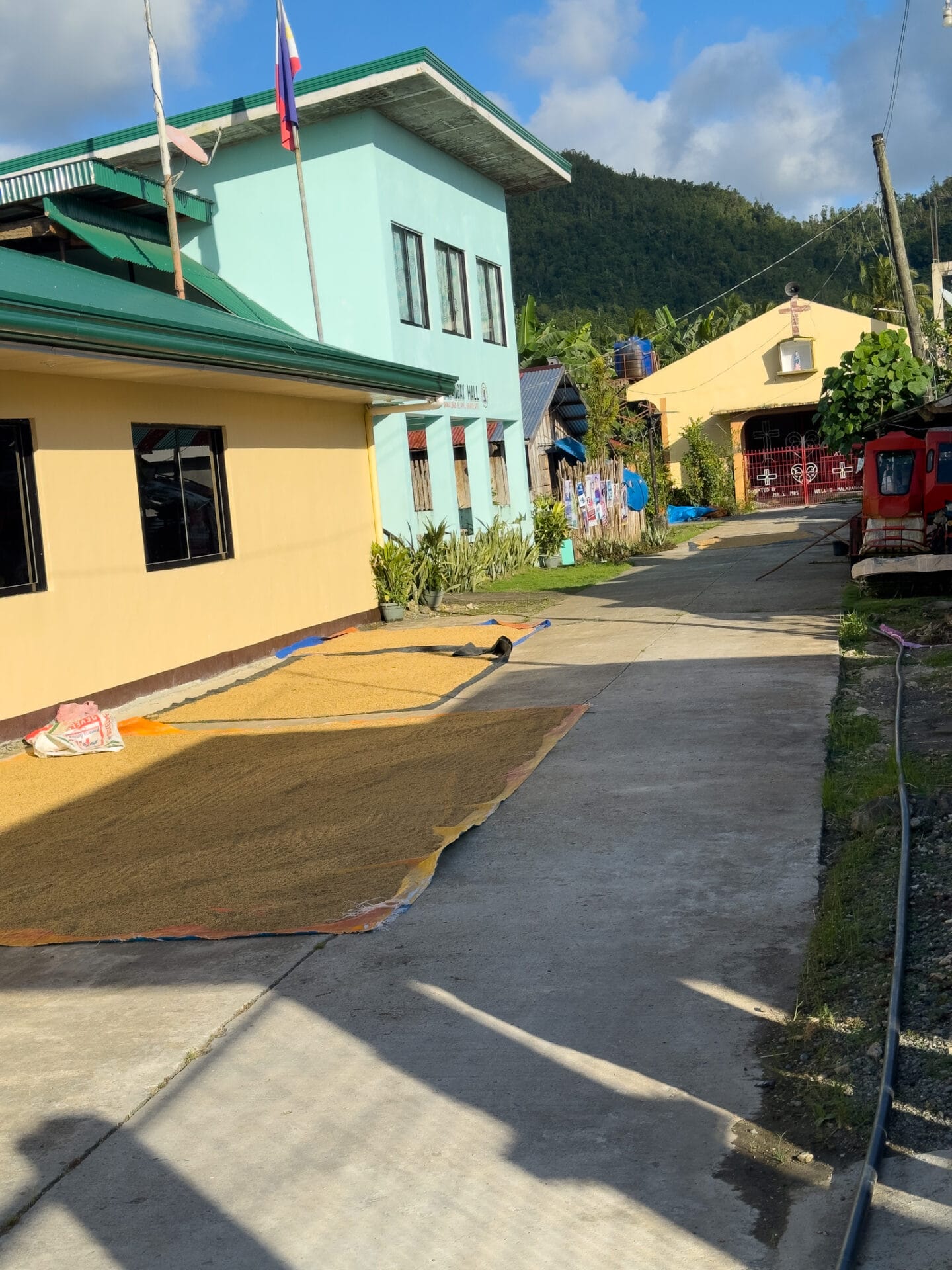
If you drive the Siargao Circumferential Road during the right season, you’ll see them: whole rice grains spread across blue tarps in front of homes, drying under the equatorial sun. Mountains of russet and burgundy catching the light, being turned occasionally by whoever’s home, the daily rhythm of post-harvest processing happening right there on the roadside.
Red rice. Earthy, unrefined, resilient. The kind of grain that’s been grown on small inland plots throughout the Philippines for generations, cultivated in a rhythm that has nothing to do with industrial agriculture and everything to do with seasonal rains and family land and the knowledge passed down from people who understood that rice isn’t just food, it’s infrastructure.
I’d see those tarps and ask Love questions. What are they doing? How long does it dry? Who grows it? The answers were matter-of-fact, the tone of someone explaining something so ordinary it barely merits explanation. This is just what happens. This is how rice works.
When cooking red rice over woodfire in a fogon, the traditional woodfire stove that still exists in many Siargao kitchens despite the encroachment of gas and electric ranges, it smells faintly of roasted grain and soil after rain. Something primal and grounding, a scent that connects you to the earth in a way that jasmine rice from a bag at the supermarket never quite manages.
I couldn’t help but want to try it at some point.
The Rice Locals Keep for Themselves
Around April, Love’s Auntie, and our neighbor, Auntie Marilyn showed up with a few kilos. No ceremony, no explanation needed. Just the understanding that we were part of the community now, that we’d appreciate trying what locals were eating, that food sharing was simply how things worked in Barangay Garcia.
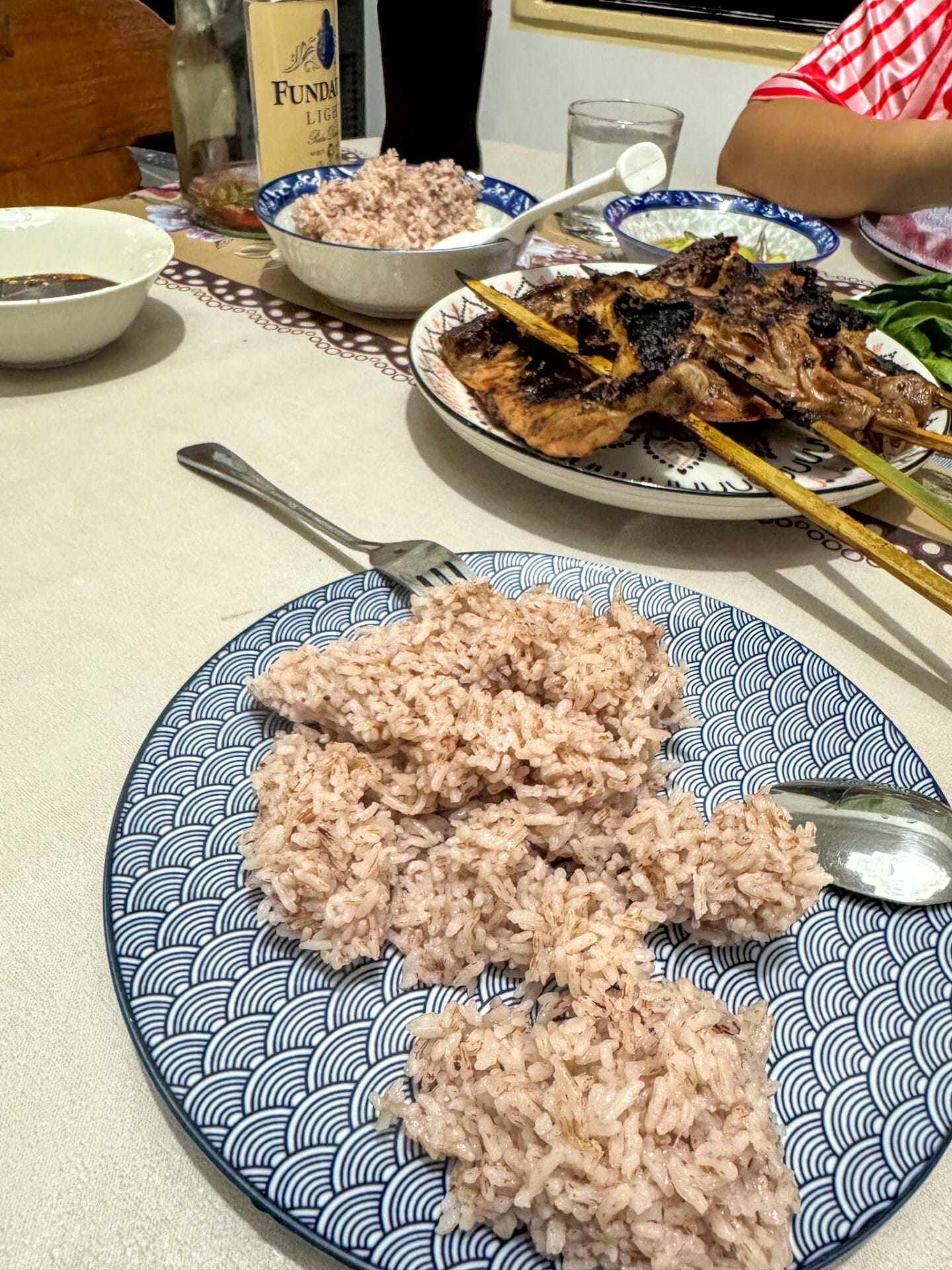
Love already knew how to prepare it—she’d grown up eating this rice, understood its rhythms and requirements without needing instruction. She taught me the technique: cook it the typical Filipino way with water, no salt. Add a splash of coconut vinegar to make it last longer in the heat, a preservation trick that extends the life of cooked rice in a climate where refrigeration isn’t always guaranteed and power outages are common enough to plan around.
The rice itself was different from the white jasmine rice we’d normally been eating, different even from the brown rice I’d grown up with in California. It had substance, a chewiness that made you work for it slightly, that reminded you with every bite that this was closer to what rice actually is before we started breeding all the character out of it.
What Red Rice Tastes Like
It tastes healthier, not in an abstract, virtuous way, but in a way you could feel. Something like brown rice but earthier, with a faint nuttiness that came through even under whatever ulam (dish) we paired it with. When cooked, the color reminded me of Belizean rice and beans, that same russet-burgundy hue that tells you this grain has retained its bran layer, all the fiber and nutrients that get stripped away in the refinement process.
The nutritional profile backed up what my body was telling me: rich in fiber, vitamins, minerals, and antioxidants. Specifically anthocyanins—the same antioxidant found in red wine, the compound responsible for that deep color. Unlike white rice, it releases sugar slowly, stabilizing blood glucose levels. Red rice is tailor-made for diabetics. Lower in heavy metals and pesticides than conventionally grown white varieties.
But none of that mattered as much as the simple fact that it tasted good, that it paired beautifully with Filipino BBQ—chicken, chorizo, atay (liver), tinae (intestines)—the charred, fatty, intensely flavored meats we’d pick up from local vendors and bring home to eat with whatever rice we had on hand. Which, increasingly, was this red rice when locals offered it to us or when the season made it abundant.
Catching & Eating Kayabang (Local Land Crabs)
A few weeks after we’d completed our move to Siargao, still figuring out which roads led where. Love’s cousin Nick John helped us navigate the practical realities of not having a car on the island. Which meant a rented motorbike and a lot of time on the road, learning our new home from the back of a two-wheeler.
One night we were riding back toward Burgos after an afternoon of exploration, the kind of aimless wandering you do when everything is still unfamiliar and potentially interesting. The roads were dark in that particular way rural Philippines gets dark—very few streetlights, sometimes the occasional glow from a house or sari-sari store, the rest swallowed by jungle and the starry night sky.
Then we started seeing them: locals with flashlights, scattered along the roadside, moving slowly, searching for something in the grass and gravel.
Nick John slowed down. At first he thought they might be hunting frogs. Frog legs are a delicacy, and night hunting with flashlights is standard practice. But as we got closer, as our headlight caught the movement, we realized what they were actually after.
Kayabang. Red land crabs. Dozens of them, maybe hundreds, emerging from wherever land crabs hide during the day and making their slow, sideways journey across the road and toward the shore.
It was a full moon. Which, I’d learn later, is when they’re most abundant near the water, something to do with spawning or food availability or ancient crustacean rhythms that predate human understanding. The locals knew. They always know. And they were out in force, taking advantage of the seasonal abundance the way people do when they’re connected to the cycles of the place they live.
Nick John looked at me. Grinned. Pulled over.
A Full Moon on the Road to Burgos
We didn’t have any fancy equipment on us that evening. No nets, no traps, no protective gloves. What Nick John had were the slippers on his feet and the reflexes of someone young enough to think grabbing wild crabs in the dark sounded like a good idea.
He slipped off his chinelas (slippers) and went to work.
The technique was simple: spot a crab with the flashlight, approach carefully, pin it down with the slipper before it could scuttle away or raise its claws defensively. The crabs weren’t passive about this. They’d rear up, claws open, ready to fight for their freedom. But Nick John was faster, more cunning, twenty-something and treating this like the most normal thing in the world.
Into the motorbike’s seat compartment they went. One crab, then another, then another. Six total by the time we decided we had enough. You could hear them scratching around in there, claws clicking against plastic, probably very confused about how their full moon journey had been so rudely interrupted.
We rode home with a compartment full of live land crabs, the absurdity of the situation not lost on me but apparently completely unremarkable to Nick John. This was just what you did during full moons in Burgos. You saw crabs on the road, you caught them, you brought them home and someone who knew what they were doing would turn them into dinner.
That someone was Love.
Love’s Ginitaang Kayabang
Love took one look at our catch and knew exactly what to do with them. No hesitation, no need to consult a recipe or call her mother for advice. This was knowledge she already carried, part of the accumulated wisdom of growing up in Surigao del Norte where seafood isn’t a restaurant category, it’s just what you eat.
She filled our wok with water and brought it to a boil. The crabs went in thrashing, then still. It’s the quickest, most humane way…over in seconds, no prolonged suffering. Then she cleaned them, a process that involves more knife work and anatomical knowledge than I possessed at the time, removing what needed removing and keeping what would become sweet, delicate meat once properly cooked.
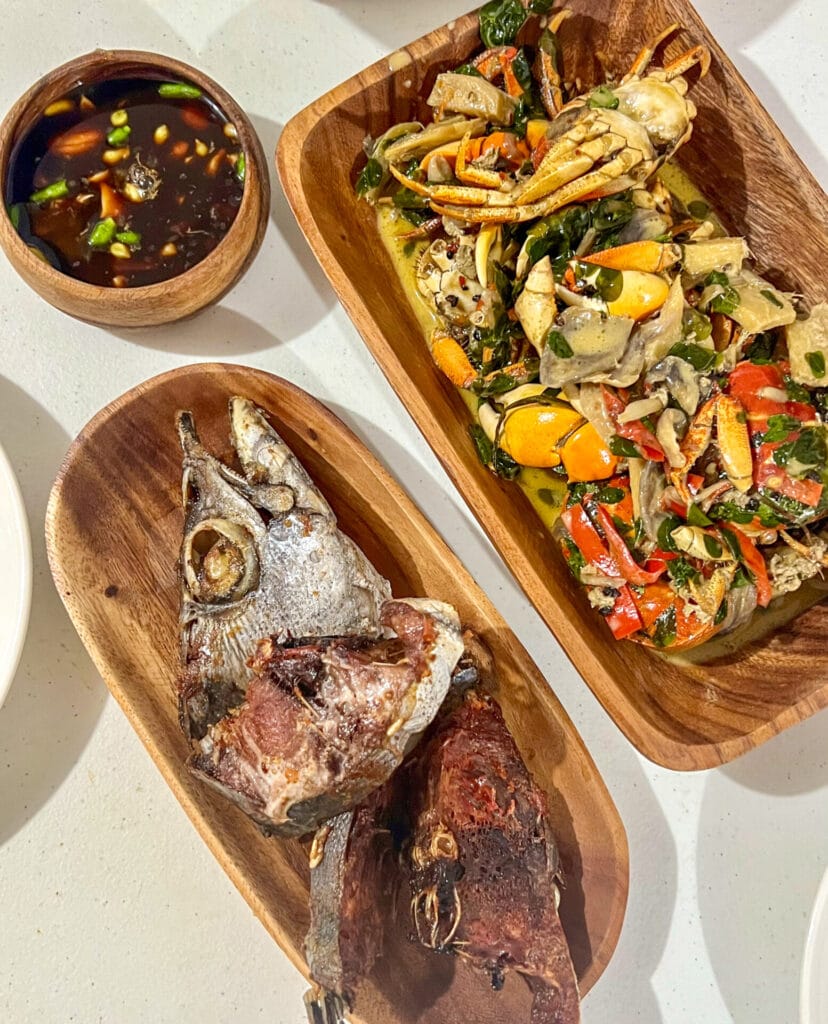
The braise she built was textbook Filipino: coconut milk as the base, ginger and lemongrass providing aromatic brightness, moringa leaves adding their subtle earthiness, onion and garlic doing what they always do. And then, unexpectedly if you’re not familiar with Filipino cooking…Sprite. The American lemon-lime soda that I’d later learn shows up in all kinds of preparations, especially kinilaw, providing sweetness and a different kind of acidity than straight citrus or vinegar.
Fresh From the Wild
The kayabang simmered in this curry, the coconut milk thickening, the aromatics infusing the crab meat, the whole thing becoming more than the sum of its parts. By the time it was done, our small kitchen smelled like the best version of coastal Southeast Asia: rich, fragrant, complex, the kind of smell that makes you understand why people have been cooking this way for generations.
We ate it with white rice and fried tuna steaks we happened to have on hand. The curry was so flavorful it almost overwhelmed the delicate sweetness of the crab. Almost. The meat was fresh, oceanic despite being land crabs, with that particular texture that only comes from crustaceans pulled from the wild rather than farmed in controlled conditions.
The only challenge was extraction. I didn’t have the right tools to crack the crab legs and claws efficiently, didn’t have the practiced technique that comes from a childhood spent eating whole crabs with just your hands. I struggled, got small amounts of meat for significant effort. Love and Nick John, meanwhile, worked through their portions with the ease of people who’d been doing this their entire lives, fingers knowing exactly where to press and pull to access every bit of edible flesh.
Coconut Water and Buwa
The Fundador had done its work the night before. I was paying the price.That particular kind of hangover that comes from rum and late nights and the overconfidence that you can drink like locals do when you very much cannot.
It was the same morning I’d try sea urchin for the first time, but that would come later. First, we needed to address the more immediate crisis: dehydration so profound it felt like the island heat was conspiring with the alcohol to turn us into desiccated versions of ourselves.
I stood in our backyard, staring up at the coconut trees that had been there since we moved in. Tall, maybe twenty feet or more, with clusters of green coconuts hanging tantalizingly out of reach. “Boy,” I murmured, more to myself than anyone, “some coconut water would really hit the spot right now.”
Cesar, standing nearby looking remarkably functional for someone who’d matched me drink for drink the night before, asked if we’d like some.
“Sure,” I said, thinking he meant we could maybe buy some from a neighbor or walk to a sari-sari store that might have some bottled. The coconuts were twenty feet up. What were we supposed to do, wish them down?
Cesar walked over to one of the trees.
And started climbing.
Climbing The Coconut Tree
Not with equipment. Not with a ladder or rope or any of the safety apparatus my California-raised mind assumed would be necessary for scaling a twenty-foot plus coconut tree. Just Cesar, barefoot, using the grooves that had been cut into the trunk—shallow notches that generations of climbers carve and maintain in Siargao, the kind of infrastructure that’s invisible until you need it.
He went up like it was nothing. Like gravity was a suggestion rather than a law. Hand over hand, feet finding purchase in grooves that looked too small to support weight, his body moving with the practiced efficiency of someone who’d done this hundreds of times. He wasn’t showing off, this was just how you get coconuts when you live in a place where coconut trees are everywhere and hardware stores selling extension poles are not.
Cesar reached the crown of the tree where the coconuts hung in clusters. He carefully selected young green ones, not the mature brown coconuts that would have harder meat and less water. Two of them at a time. He twisted them loose and expertly carried them down using his forearms to descend the coconut tree.
Then he came back down, just as casually as he’d gone up, and landed in our backyard like he’d just stepped off a curb rather than descended from twenty feet in the air.
Opening Fresh Buko
I had my machete handy and passed it to Cesar, who took it and began opening the coconuts with the kind of knife work that comes from muscle memory rather than conscious thought. Clean cuts, precise angles, the green husk peeling away to reveal the white shell underneath, then careful strikes to open the top without spilling the precious buko juice (coconut water) inside.
He poured the fresh buko juice into a cold glass pitcher we’d brought out. Clear, slightly sweet-smelling, still cool from having been insulated by layers of husk and shell and height above the sun-baked ground.
Sweet Rehydration
That first sip went down like salvation.
Cool from the glass pitcher, naturally sweet in a way that has nothing to do with added sugar and everything to do with what coconut trees pull from tropical soil and equatorial sun. It went down smooth, almost slippery, coating my throat and immediately beginning the work of rehydration that my body was desperately demanding.
Nothing, and I mean nothing, could have remedied our hangovers better. Not Gatorade, not pedialyte, not the overpriced coconut water that is sold in Trader Joes or Whole Foods. This was the real thing, hours-fresh, poured directly from young green coconuts that had been hanging in our backyard the entire time we’d been suffering.
Love drank alongside us, observing the whole scene with the mild amusement of someone watching foreigners discover things she’d known her entire life. Cesar looked more human with each glass. I could feel my brain slowly remembering how to function.
And then Cesar noticed the pile.
Discovering Buwa
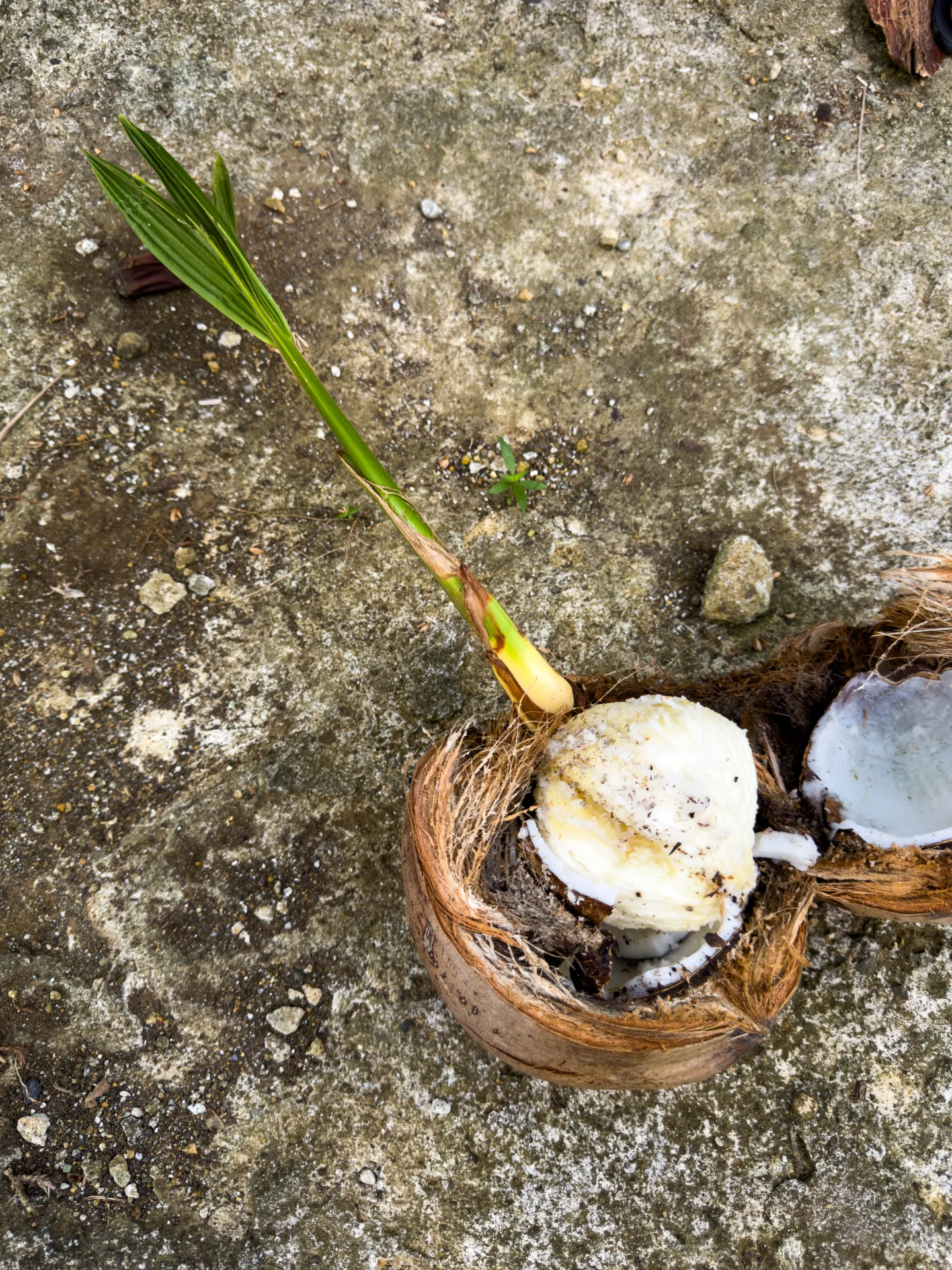
In our backyard, somewhat forgotten, was a collection of coconuts that had been sitting there for weeks. Not fresh green ones like he’d just harvested, but older ones that had already started sprouting—those strange-looking coconuts with shoots emerging from one end, the beginning of new palm trees if left undisturbed long enough.
“Have you tried buwa?” Cesar asked, walking over to the pile.
“What’s that?” I responded.
I was familiar with the concept and knew that sprouted coconuts developed this weird spongy interior, I had heard of it in Belize. But I’d never connected it to the Visayan word, had never actually eaten it.
Cesar picked up one of the sprouted coconuts and went to work with the machete. Peeling away the husk, cracking the shell, revealing what was inside: white coconut flesh that looked nothing like the firm, oily meat you scrape from regular coconuts. This was different. Lighter, almost ethereal. It looked like coconut-flavored cotton candy, all air and delicate structure.
He handed me a piece.
Tasting Buwa
I took my first bite, and the texture was unlike anything I’d experienced before. Airy and crisp, yet somehow oily at the same time, a contradiction that shouldn’t work but absolutely did. It dissolved on my tongue, this delicate matrix of coconut that had transformed itself in the process of trying to become a tree.
The flavor was coconutty but subtle, not as intense as fresh coconut meat. Not particularly sweet, not bland either. Just this clean, pure essence of coconut that tasted, and I know how this sounds, healthy. Like you could feel it doing good things for your body even as you chewed.
Which, it turns out, it was.
Buwa is rich in MCTs (medium-chain triglycerides) the kind of fats that get absorbed and used for energy quickly, unlike the long-chain fats that require more processing. It’s loaded with manganese, copper, and selenium. Plenty of fiber. Antioxidants. All the nutritional buzzwords that usually come attached to expensive superfoods at trendy grocery stores, except this was just growing in our backyard, free for the taking if you knew what to look for and how to open it.
The Education, Not Just the Remedy
I ate one or two pieces, savoring the strange texture, the lightness of it. Cesar didn’t have any—he’d eaten plenty before, and this was clearly for my benefit, another item on the unofficial curriculum of “things the foreigner should try while living in Siargao.”
Love watched, drinking her coconut water, probably mentally cataloging this moment for future retelling. Her hungover boyfriend eating sprouted coconut in their backyard while their electrician friend casually demonstrated skills that would seem superhuman anywhere else but were just Tuesday morning competence here.
The buko juice had rehydrated us. The buwa had given us something solid, something grounding. And both had come from trees that were just standing there in our yard, waiting for someone with the knowledge and ability to harvest them properly.
I was grateful. For the remedy, yes, but more for the education. Cesar’s willingness to scale a twenty-foot coconut tree and share what he knew meant everything. Love’s patience with my constant discovery of things she’d always taken for granted mattered just as much. Living in a place where hangovers could be cured by looking up instead of driving to a convenience store.
Coconut Vinegar
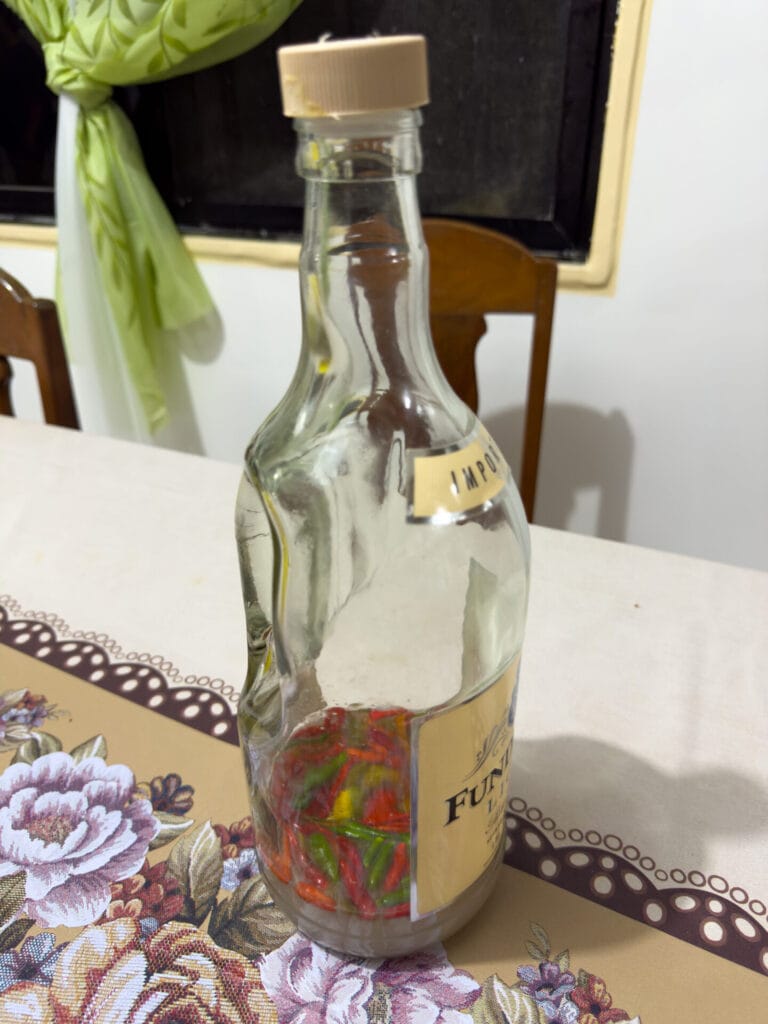
If you were to look in our kitchen at any given moment during our one and a half years in Siargao, you’d find a recycled Fundador bottle filled with cloudy coconut vinegar, packed with small red siling labuyo chilis floating like suspended fire. Sometimes the bottle would be nearly empty, sometimes freshly filled, but it was always there. Always within reach.
Coconut vinegar became my go-to ingredient in Siargao. Not by intention or culinary philosophy, but by simple fact: virtually every Filipino meal we ate at home involved this milder, fruitier, more complex vinegar. It was the base note that everything else harmonized with, the ingredient so fundamental it became invisible until you stopped to think about what would be missing without it.
It’s subtly sweet without being cloying. Fruity in a way that’s hard to pin down—floral notes, earthy undertones, something that tastes like tropical sun and fermentation and time. And coconutty, if that’s even a word, though not overwhelmingly so. Just enough to remind you where it came from, what tree it dripped from, what process transformed sweet sap into tangy acid.
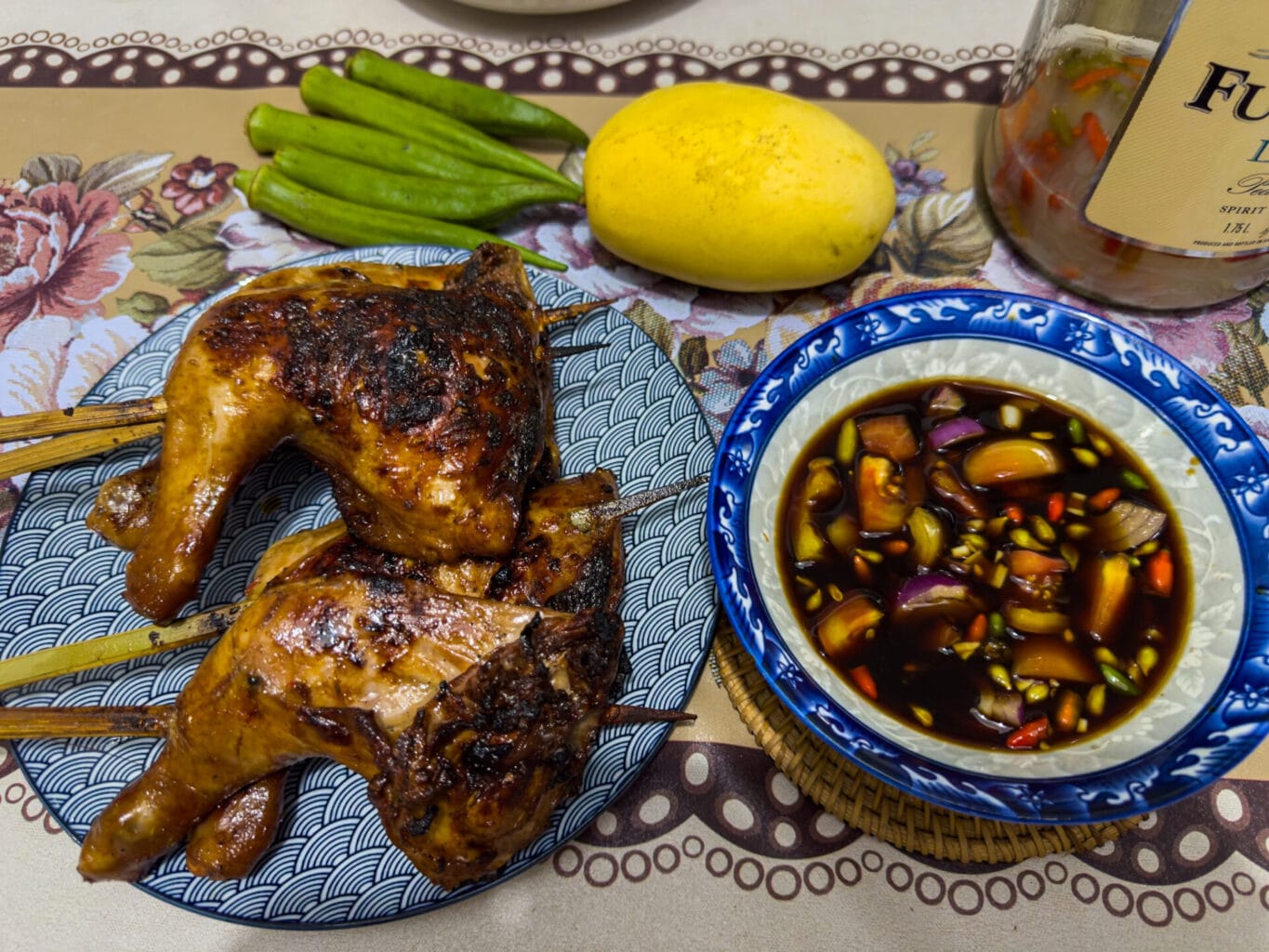
We used it constantly. Mixed with soy sauce, calamansi, and those same siling labuyo for a dipping sauce that accompanied everything from grilled fish to lechon. Blended with calamansi, onions, chilis, and tomatoes for Love’s adobo, for cornbeef silog breakfasts, for pulutan during drinking sessions with our friends and family. It was the essential component in Love’s kinilaw, that sea urchin and danggit dish Cesar had introduced me to, the octopus we’d grill, any raw seafood that needed acid to cure it and flavor to elevate it.
But not all coconut vinegar is created equal.
How We Source Our Suka (Coconut Vinegar) in Northern Siargao
There are plenty of packaged industrial coconut vinegars available. You can find them in any grocery store, bottled and labeled and consistent in a way that mass production demands. They’re fine. They do the job. But they taste like what they are, manufactured products designed for shelf stability and broad distribution rather than flavor and character.
We source ours from a fishball vendor in Little Hawaii.
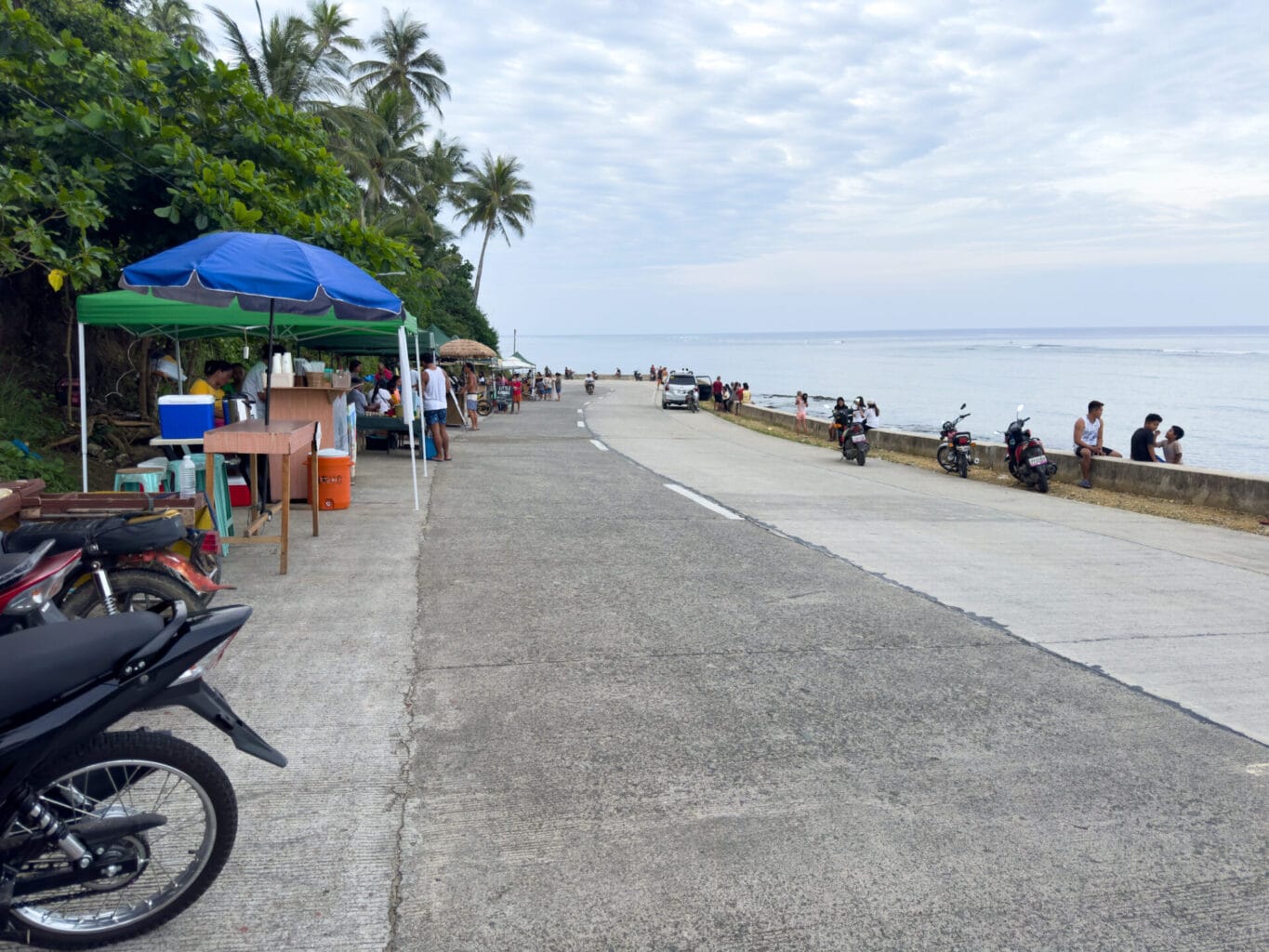
Little Hawaii isn’t a resort or a tourist destination, despite the name. It’s a cluster of street food vendors situated where the road bends around a mountain, revealing the postcard-perfect sweep of Lawan Beach. The kind of spot where locals stop for a quick meal, where the food is cheap and good and nobody’s trying to charge you foreigner prices because you’re just another customer in line.
The fishball vendor, I never learned his name, but he runs what might be the best street food stall in Little Hawaii, specializing in homemade fishballs. The kind of stuff that sounds humble until you taste his version and realize how much craft can go into food that costs a few pesos.
Pure, Uncut, Straight From the Source
We’d eat there sometimes, and Love noticed something: his vinegar was exceptional. Not the industrial stuff, not diluted or neutral or merely functional. This was pure, fresh, seemingly straight from coconut blossoms. You could taste the difference immediately—floral and earthy notes that the packaged versions had lost somewhere in processing and storage. It didn’t taste diluted or standardized. You got the pure essence, the full expression of what coconut vinegar could be when someone who knew what they were doing made it in small batches.
Love, being Love, asked if they’d be willing to sell us some.
They were. And suddenly we had access to organic coconut vinegar that became the perfect base for blending our own suka pinakurat (our infused version of coconut vinegar), packed with siling labuyo in recycled Fundador rum bottles, left to steep until the heat and the acid married into something greater than either component alone.
How Coconut Vinegar Is Made
In Siargao, it’s common for locals to ferment their own coconut vinegar. Not as a hobby or artisanal project, but as basic household production, the way people in other places might grow tomatoes or bake bread. If you have coconut trees, and most people do, you have the raw material. All you need is knowledge, some elbow grease, and patience.
The process starts with tuba, the coconut sap collected from the blossoms. Climbers go up, the same way Cesar scaled our backyard trees, and tap the flowering stems, collecting the clear, sweet liquid that drips out. This is the first stage, and it’s already valuable: fresh tuba is mildly alcoholic, slightly effervescent, a drink that locals indulge in straight from the source.
But if you let it sit, let the yeasts do their work, the sugar converts to alcohol. Then bacteria take over, converting that alcohol into acetic acid through a secondary fermentation. What emerges is cloudy vinegar, rich with probiotics, alive in a way that pasteurized commercial products can never be. The fruity flavor only deepens with age, developing complexity that takes time to build and can’t be rushed.
Participating in Something Old
I have a bottle of 20-year aged tuba sitting in our kitchen. Haven’t opened it yet. Don’t even know what it’ll taste like after two decades of fermentation, but the anticipation is part of the experience. Some things are worth waiting for.
The fishball vendor’s vinegar wasn’t aged that long (probably weeks or months rather than years), but it carried that same living quality, that sense of being connected to a continuous process rather than a factory line. When we packed it into our Fundador bottles with fresh chilis, we were participating in something old, something that predated colonization and commercialization and the notion that condiments should come in branded plastic squeeze bottles.
Conclusion
One and a half years in Northern Siargao taught me something YouTube videos nor guidebooks mention: the best local food experiences happen when you stop being a tourist and start being a part of the community.
You can’t replicate any of this on a week-long vacation. That’s the point. But you can taste it if you’re willing to eat where locals eat, ask questions, say yes to things that seem strange, and understand that the best meals rarely happen in restaurants. The fishball vendor in Little Hawaii with the exceptional vinegar. Locals catching crabs during full moons. The neighbors who’ll share their red rice harvest because that’s just what people do.
If you’re coming to Siargao, yes, go to Cloud 9 and eat at the restaurants in General Luna. But also eat at the street stalls, try the kilaw, ask about the vinegar, notice the red rice drying on tarps by the road. The island’s real food culture exists in the spaces between the tourist stops—in barangays like Garcia where generational knowledge still matters and sharing is infrastructure.
What people eat tells you how they live. In Northern Siargao, people live connected to seasons and tides, to coconut trees and fishing grounds, to communities where food is how strangers become neighbors. That’s the education worth having, even if you’re only visiting.
The best thing you can eat in Siargao isn’t on any menu. It’s whatever someone local is willing to share with you if you show up with respect, curiosity, and an empty stomach.
Links To Our Other Posts About Life In Siargao
Want to read more about our island life experience? Here are links to some of our other posts about Siargao:
Top 5 Hidden Gems of Siargao Island’s North Side
My Top 16 Food Finds In Siargao Island (In No Particular Order!)
Ready for your Siargao north-side adventure? Let us know in the comments which gem you’re excited to visit first!